Manas Birding & Wildlife Trip – February 2025
From the grasslands and forests of Manas National Park to a night across the border in Royal Manas, Bhutan, this six-day journey combined exceptional birding with memorable wildlife encounters. Bengal Florican was one of the defining birds of the trip, while Wreathed Hornbill highlighted our time in Bhutan.
Into the Wilds of Manas
In February 2025, I travelled with a small group of four participants on a six-day birding and wildlife journey to Manas National Park in Assam.
We started from Guwahati and drove to Manas, where we stayed at a jungle camp close to the forest. Over the following days, we explored different parts of the landscape, including the Bansbari and Bhuyanpara ranges.
Our birding was deliberately varied. Inside the national park, we explored by jeep, which allowed us to cover the grasslands, woodland and riverine areas while also looking for Manas’s larger mammals. Outside the park, we spent time birding on foot along forest trails, where the slower pace gave us opportunities to concentrate on smaller forest species.
We also included night birding for owls and owlets, before extending the journey across the border for a night in Royal Manas National Park in Bhutan.
By the end of the six days, we had recorded 130 bird species plus two additional taxa, and the participants had added more than 20 lifers during the journey.
Searching for the Bengal Florican
One of our primary targets in Manas was the Bengal Florican, and it became one of the major highlights of the tour.
Manas protects extensive areas of grassland, and birding these open habitats is very different from working the forests. Instead of concentrating only on nearby vegetation, we spend considerable time scanning distant grassland, watching open patches and looking for movement.

Our patience was rewarded with Bengal Florican, with three birds recorded across two of our checklists during the journey.
For me, seeing a Bengal Florican in the grasslands of Manas is much more than adding another species to a checklist. It is one of those birds that belongs completely to its landscape, and seeing it here helps you appreciate why protecting these grasslands is so important.
The open habitats also produced birds such as Bengal Bushlark and Indian Grassbird, while raptors included Pied Harrier, Steppe Eagle, Changeable Hawk-Eagle, Crested Serpent-Eagle, Himalayan Griffon and Oriental Honey-buzzard.
Birding Beyond the Grasslands
Manas is sometimes associated primarily with its grasslands and large mammals, but its bird diversity extends much further.
As we explored the wooded habitats and trails, the bird community changed considerably.
The trip produced an excellent selection of woodpeckers, including Gray-capped Pygmy Woodpecker, Fulvous-breasted Woodpecker, Greater Flameback, Lesser Yellownape, Gray-headed Woodpecker and Greater Yellownape.
Collared Falconet was another excellent sighting. Other forest birds included Sultan Tit, Gray-bellied Tesia, Chestnut-headed Tesia, Abbott’s Babbler, Blue-winged Minla, Red-tailed Minla, Rufous-necked Laughingthrush and Greater Necklaced Laughingthrush.

Blue-bearded Bee-eater, Indochinese Roller, Asian Fairy-bluebird, Little Spiderhunter and Streaked Spiderhunter added even more variety to the six days.
This variety is one of the reasons I find Manas such a rewarding birding destination. Moving between grassland, woodland, riverine areas and forest trails can completely change the birds we are looking for within the same journey.
After Dark: Owls and Owlets of Manas
Our birding did not finish when daylight disappeared.
We spent time night birding around Manas specifically looking for owls and owlets, and this became another particularly productive part of the journey.
Across the trip we recorded Collared Scops-Owl, Oriental Scops-Owl, Spot-bellied Eagle-Owl, Asian Barred Owlet, Spotted Owlet and Short-eared Owl.
Night birding changes the experience completely. Familiar forest tracks feel very different after dark, and finding these birds depends heavily on listening, patience and understanding where different species are likely to occur.
The Spot-bellied Eagle-Owl was particularly notable among an excellent collection of nocturnal birds.
Tigers, Rhinos and Elephants
Although birding was a major focus of our journey, it is almost impossible to visit Manas without being drawn into its larger wildlife.
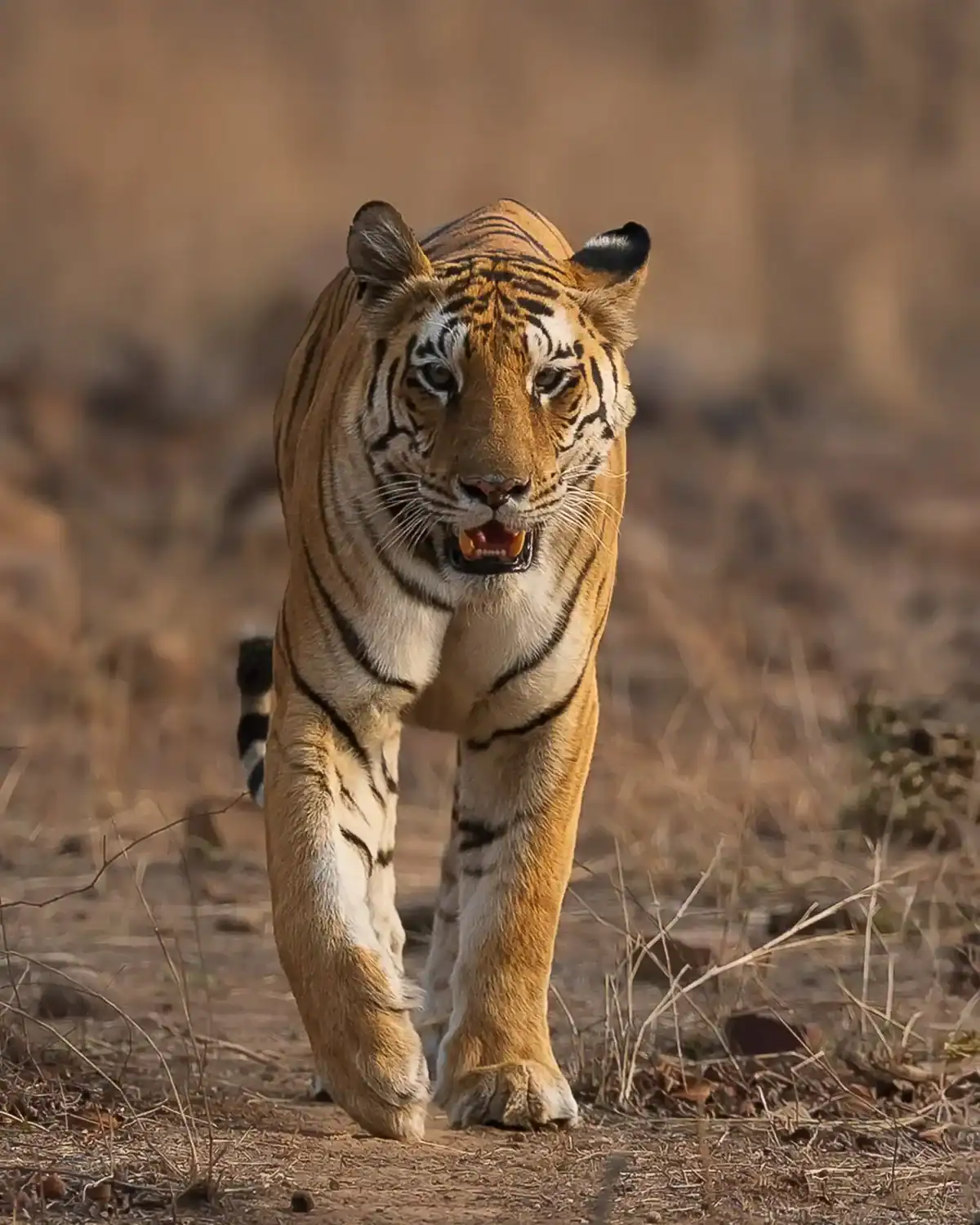
Our jeep drives through the national park produced some memorable mammal encounters, with the biggest highlight being a Royal Bengal Tiger.

We also encountered Greater One-horned Rhinoceros, Asian Elephants and Capped Langurs, among other mammals.
This is one of the qualities that makes Manas different from a destination visited purely for birding. We may begin a drive looking for a Bengal Florican or a particular raptor, but the same morning can suddenly produce an elephant herd, a rhino or, with considerable luck, a tiger.
For a naturalist, that combination makes every drive unpredictable.
Crossing into Royal Manas, Bhutan
One of the most interesting parts of this journey was extending our exploration beyond the Indian side of Manas.
From Manas National Park, we crossed into Bhutan and travelled into Royal Manas National Park, where we spent one night.
Although politically separated by an international border, the forests form part of a much larger connected natural landscape. For us as birders, crossing into Bhutan also provided an opportunity to search a different part of this ecosystem and its birdlife.

The major highlight of our time in Royal Manas was the Wreathed Hornbill.
Hornbills were exceptionally well represented during the overall journey. In addition to Wreathed Hornbill, our checklist included Great Hornbill, Oriental Pied-Hornbill and Rufous-necked Hornbill, giving us four hornbill species during the trip.
Seeing Wreathed Hornbill in Bhutan was a fitting highlight of our short extension into Royal Manas and added a completely different dimension to what could otherwise have been a conventional Manas itinerary.
More Than a Bird Checklist
By the end of our six days, the eBird list stood at 130 species plus two additional taxa. But numbers alone don’t really describe this journey.
We had searched the grasslands for Bengal Florican, explored different ranges of Manas by jeep, walked forest trails, gone out after dark looking for owls and owlets, watched some of India’s most impressive mammals and crossed into Bhutan to experience Royal Manas.
For the participants, more than 20 lifers made the journey particularly productive.
But some memories inevitably stand above the numbers: Bengal Florican in the grasslands, a Royal Bengal Tiger in Manas and Wreathed Hornbill across the border in Bhutan.
Together, they captured three very different sides of this remarkable landscape.
Reflections from Manas
What I enjoy about Manas is that it rewards us for looking beyond a single species or a single type of experience.
The grasslands demand patience and long-distance observation. Forest trails require us to slow down and listen. Night birding introduces an entirely different group of birds. And during a jeep drive, attention can shift instantly from birds to elephants, rhinos or a tiger.
Having different habitats within the same landscape also means that understanding where and when to spend our time becomes particularly important.
Our February 2025 journey demonstrated exactly that. By combining Bansbari and Bhuyanpara, jeep-based exploration inside the national park, birding trails outside it, night birding and a short extension into Royal Manas, we experienced far more than a conventional wildlife safari.
For me, that diversity is what makes Manas one of the most exciting birding and wildlife destinations in Northeast India.
Complete Bird Checklist
During our six-day Manas and Royal Manas journey, we recorded 130 bird species plus two additional taxa across five eBird checklists.
Highlights included Bengal Florican, Wreathed Hornbill, Rufous-necked Hornbill, Great Hornbill, Spot-bellied Eagle-Owl, Oriental Scops-Owl, Collared Falconet, Blue-bearded Bee-eater, Sultan Tit and a remarkable variety of forest and grassland birds.
For the complete species list, counts and observations recorded during the journey, view our official eBird Trip Report.
View Complete eBird Trip Report →
Journey Summary
Tour Dates
17–22 February 2025
Route Followed
Guwahati → Manas National Park → Royal Manas, Bhutan → Manas
Duration
6 Days
Areas Explored
Bansbari and Bhuyanpara ranges of Manas National Park, surrounding birding trails and Royal Manas National Park in Bhutan.
Habitats Covered
Terai grasslands, tropical and subtropical forests, woodland, riverine habitats and forest trails.
Key Birding Highlights
Bengal Florican, Wreathed Hornbill, Rufous-necked Hornbill, Great Hornbill, Spot-bellied Eagle-Owl, Oriental Scops-Owl, Collared Falconet, Blue-bearded Bee-eater and Sultan Tit.
Wildlife Highlights
Royal Bengal Tiger, Greater One-horned Rhinoceros, Asian Elephant and Capped Langur.
Trip Experience
Jeep-based birding and wildlife exploration inside Manas, birding on forest trails, night birding for owls and owlets, and an overnight extension to Royal Manas in Bhutan.
Expedition Led By
Manmohan Uniyal
Join Our Next Manas Birding Tour
Manas offers something that relatively few birding destinations can combine within one journey: rare grassland birds, rich forest birdlife, excellent nocturnal birding and some of India’s most impressive mammals.
At World of Wild, we explore Manas according to the interests of the group rather than treating every visit as a standard safari itinerary. For dedicated birdwatchers, this means spending time in different habitats and ranges, exploring trails outside the park and searching for species such as Bengal Florican, hornbills, owls and other regional specialities.
For photographers and nature lovers, the journey can also balance birding with opportunities to photograph wildlife and experience the wider landscape.
Explore our dedicated Manas birding tour to plan your own journey into this remarkable part of Northeast India.
View Manas Birding Tour →